Portfolio

The engine has already produced programs.

A design platform is only credible if something comes off it. Two programs have been designed on the TriaX engine and out-licensed to TriaX Therapeutics, which owns composition of matter and runs the biology. They are described here at programme level: the shape of each one, and what stage it has actually reached. Targets, chemistry and candidate structures are held back while intellectual property is secured.

The point of an engine is the second program, and the tenth — not the first.

Two programs from one engine — and the engine is the asset that stays.

Programs out-licensed

Both are induced-proximity small molecules that engage two non-redundant disease drivers with a single designed compound, rather than combining two separate drugs. Both were designed, ranked and handed across under licence. Neither is disclosed further at this stage.

PROGRAM 01

Dual-node degrader

A single molecule that drives degradation of two independent nodes a tumour cell depends on at once. The rationale is synthetic lethality: two machineries that a cell cannot compensate for separately, engaged simultaneously, so escape would require rewiring both at the same time.

Area
Oncology
Modality
Induced-proximity degrader
Rights
Out-licensed · TriaX Therapeutics
PROGRAM 02

Dual-node degrader

The same design logic applied to a second, orthogonal pairing — built from a shared anchor and a different partner node, which is precisely the reuse an engine is supposed to deliver. A second program that costs a fraction of the first is the difference between a platform and a one-off.

Area
Oncology
Modality
Induced-proximity degrader
Rights
Out-licensed · TriaX Therapeutics

Stated plainly: both programs are at the design-and-synthesis stage. What has been delivered is a ranked set of computationally designed candidates with the provenance behind every judgement — not confirmed binders. Binding data is the gating milestone for both, and we would rather say so here than imply a maturity neither program has yet earned.

The programs are the output. The engine is the asset.

TriaX AI designs the molecules and retains the platform and its methods. TriaX Therapeutics takes licensed leads into synthesis and biology, owns composition of matter on the resulting compounds, and runs the programs. Licences are exclusive, field-limited and granted program by program — so the engine stays reusable across future pairings while each program carries its own composition IP.

One design axis, three assemblies

Linker differentiation induces structural assembly differences. The same two protein modules and the same pair of anchors, re-bridged at different lengths, produce materially different complexes — so the bridge is not plumbing between two halves, it is the design variable that decides what the assembly becomes.

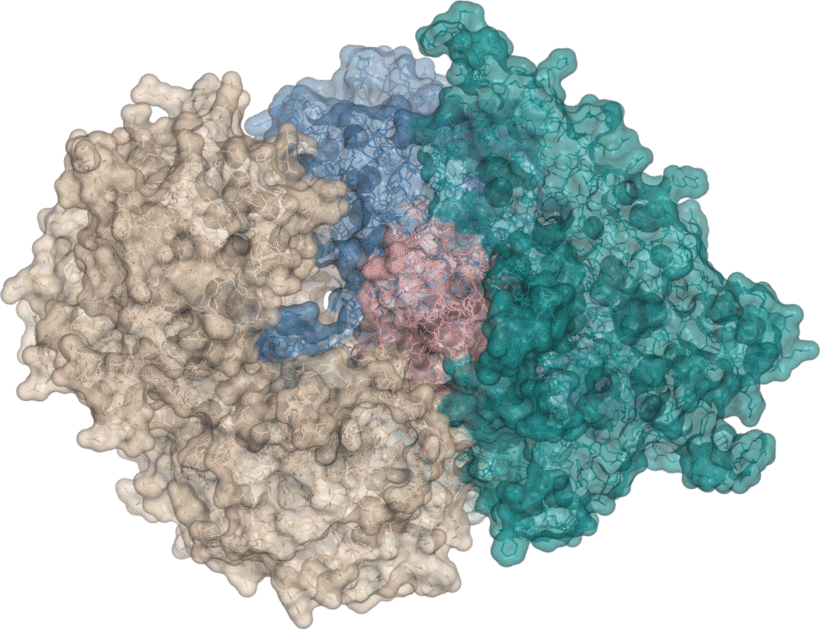
Surface rendering of a modelled multi-protein induced-proximity assembly
A multi-protein induced-proximity assembly, rendered from our own structural models. Molecular surfaces only — protein identities, chain assignments and the designed compound are not shown.
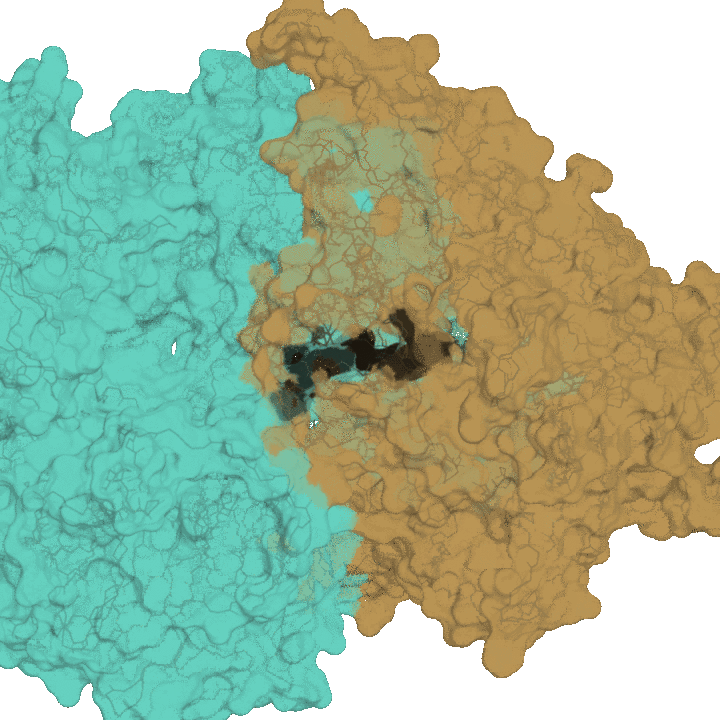
Cutaway of the assembly with an extended bridge between the two modules
EXTENDED The bridge holds the two modules apart. Proximity by tether.
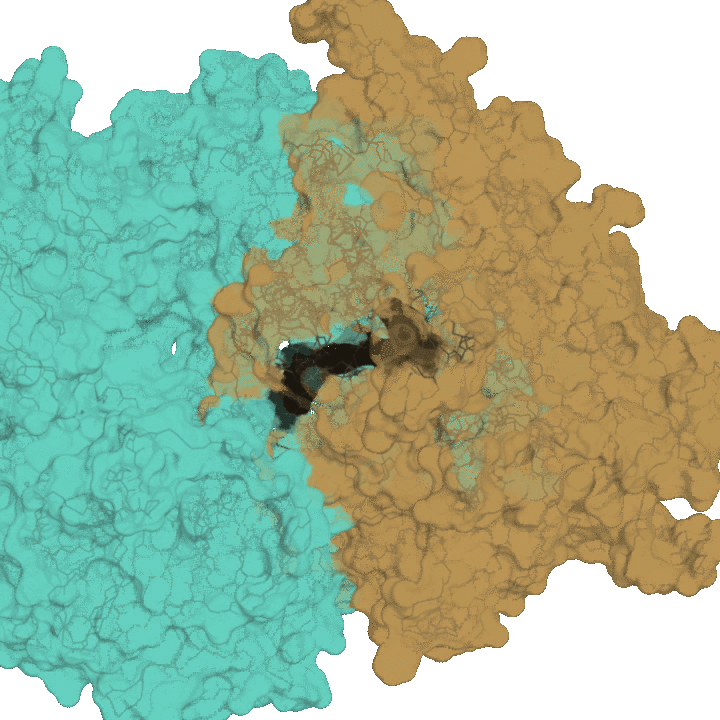
Cutaway of the assembly with a compacted bridge, module surfaces approaching
COMPACTED A shorter bridge draws the surfaces together. Contact begins.
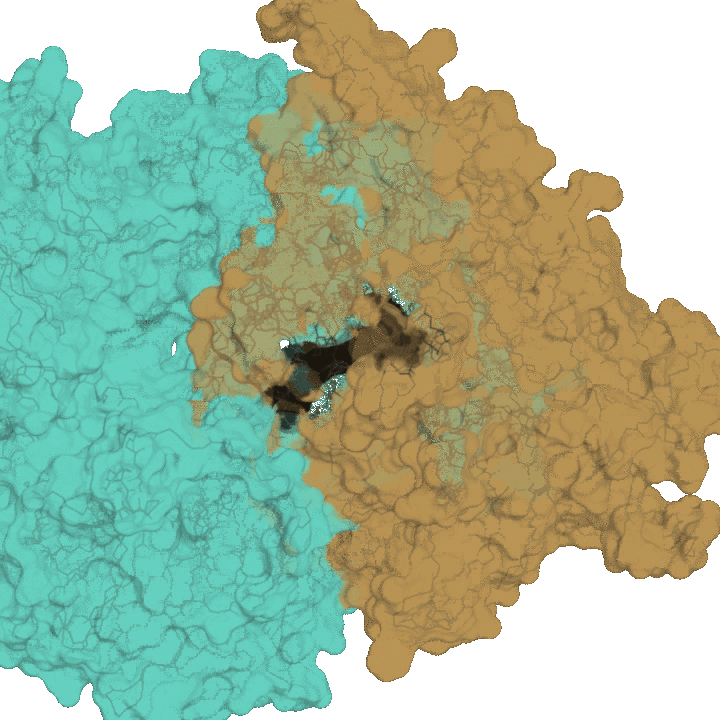
Cutaway of the assembly with a fused bridge and direct contact between modules
FUSED A short, rigid bridge. The modules meet across a cooperative interface.

Cutaway views of the same modelled assembly, rendered from our own structural models under a single fixed camera so the three states are directly comparable. The designed compound is shown in black as a solid volume only — its chemistry is not depicted. Module colours denote the two halves of the assembly and carry no protein assignment.

CONSEQUENCE 01

Tether or interface

An extended bridge holds two modules near each other without bringing them into contact — proximity, but not cooperativity. Shorten it and the surfaces meet, producing a genuine interface between the proteins rather than a molecule merely spanning the gap.

CONSEQUENCE 02

Pre-organisation

A long flexible bridge samples an enormous number of shapes, only one of which is productive. A short rigid bridge is locked into a defined geometry before it ever meets the target — a materially smaller entropic price to pay on binding.

CONSEQUENCE 03

Developability

The compact form reaches the same assembly with substantially less molecular bulk. That shows up immediately in the physicochemical profile, which is why bridge length is treated as a developability decision from the first design rather than a property to repair later.

The trade-off, stated: intimate contact demands modules that are sterically compatible with sitting against one another. Where two modules are too large or too awkwardly shaped to do so, compaction is not available and the extended form remains the correct design. The axis is a range to be chosen along deliberately — not a ladder where the tightest option is always the right one.

Designed for breadth

The two licensed programs sit inside a much wider map of candidate pairings. Because the engine reasons about interaction geometry rather than a single target family, the same process applies across areas — and across both directions of proximity: bringing a protein to a degradation machine, or holding two proteins together to stabilise a complex.

01

Oncology

Two disease drivers engaged at once by one molecule, chosen for non-redundancy so escape has to solve both problems simultaneously.

02

Haematology

Clinically de-risked degradation machinery redirected to co-degrade an additional driver.

03

Neurology

Proximity used to stabilise a protein complex rather than destroy it — the same design problem, run in the opposite direction.

04

Immunology

An established proximity-presenting protein redirected toward new effectors.

Across modalities Degradation Stabilisation Bivalent design Antigen-directed delivery
The specifics exist — they sit behind a CDA.

Target pairs, designed structures, ranked shortlists, scoring provenance and programme data are all documented and available to partners under confidentiality. If you are evaluating induced-proximity platforms, tell us the interaction class you care about and we will set up a secure channel before discussing anything sensitive.

Talk to the team →