Overview

An engine that designs the molecule that holds two proteins together.

Most of the proteome has no pocket to bind. Induced proximity gets round that by changing the question, not what fits this site, but what geometry brings these two proteins into productive contact. TriaX built an engine that answers it: proteins allowed to move across their whole interaction surface, every possible bridge between them enumerated rather than sampled, and the surviving designs ranked by whether an independent model can rebuild the assembly they were designed to produce.

The molecule is the output. The engine, and the discipline that governs it, is the asset.

One engine. Four programs. And a record of what it has and hasn't shown.

What the engine builds

A proximity drug does not act on two proteins. It acts inside a machine, target, effector, the scaffolding that holds them, and the designed molecule between. The engine designs into that whole assembly rather than into a two-body cartoon.

Illustrative. A multi-protein induced-proximity assembly, rendered from our own structural models. The motion is an imposed path under elastic-network relaxation, restraints hold each protein’s fold while repulsion resolves overlap between them. It is not molecular dynamics and not evidence that this arrangement is populated. Molecular surfaces only; protein identities and the designed molecule’s chemistry are not shown.
01

Flexibility first

Backbone motion, side-chain repacking and anchor rotation run as one procedure across the entire landscape, never as a filter on a shortlist. A triage over a handful of arrangements is not a verdict about the rest.

02

Connectability as geometry

Whether two anchors can be joined is a topological question about the directions available to each, not about whether they happen to face one another. Searching only for facing pairs manufactures false negatives.

03

Design into the assembly

Bridge geometry and fusion chemistry are proposed against every component present, with the surrounding machinery treated as excluded volume. A bridge that is legal between two isolated proteins and illegal inside the complex is one you want to find now.

How we know the engine works

A design platform is judged on whether its verdicts hold, and a verdict is only as good as the sampling and the controls behind it. These are the checks, not the candidates.

01

It rebuilds known answers

Given only sequences and a compound, the ranking model reconstructs deposited induced-proximity complexes to within about two ångströms on the arm where it is licensed. Recovery on knowns is what earns an opinion about unknowns.

02

It searches to depth

Bridge feasibility is decided over the complete enumerated landscape, in one recent determination, more than 190,000 candidate arrangements, rather than over a ranked sample of it.

03

It returns clean negatives

When no legal bridge exists, the engine says so and says why. A decisive, controlled negative is a result the platform can act on, and a capability that separates a search engine from a wish.

04

It records what it has not shown

Where a method has not been validated for a case, that case is marked unlicensed and its output is not used. An insufficiently searched negative is recorded as not searched to depth, never as not there.

Stated plainly: what leaves the engine is a ranked set of specific, synthesisable molecules with the provenance behind every judgement, not confirmed binders. Binding data is the gating milestone and no amount of further computation substitutes for it. The validation standard is set out in full on the science page →

Four programs from one engine

All four are induced-proximity small molecules that engage more than one non-redundant disease driver with a single designed compound, rather than combining separate drugs. Two are licensed to TriaX Therapeutics, which owns composition of matter and runs the biology. A third is a new four-body architecture, three proteins held by one molecule, designed on a purpose-built pipeline. The fourth is run on an external partner's targets, with the designs theirs and the methods ours.

PROGRAM 01

Dual-node degrader

A single molecule that drives degradation of two independent nodes a tumour cell depends on at once. The rationale is synthetic lethality: two machineries a cell cannot compensate for separately, engaged simultaneously, so escape would require rewiring both at the same time.

Area
Oncology
Modality
Induced-proximity degrader
Rights
Licensed · TriaX Therapeutics
PROGRAM 02

Dual-node degrader

The same design logic applied to a second, orthogonal pairing, which is precisely the reuse an engine is supposed to deliver. A second program that costs a fraction of the first is the difference between a platform and a one-off.

Area
Oncology
Modality
Induced-proximity degrader
Rights
Licensed · TriaX Therapeutics
PROGRAM 03

Four-body assembly

Three proteins held in one designed complex by a single small molecule, rather than the two-protein pairing every proximity drug on the market relies on. Adding a body multiplies the arrangements to enumerate and the interfaces that must be compatible at once, so the search had to be rebuilt; the geometry-first treatment carries over unchanged, which is why the step was available at all.

Area
Oncology
Modality
Higher-order induced proximity
Rights
TriaX AI · provisional in preparation
PROGRAM 04

Partner programme

Molecular glue and antigen-directed conjugate pipelines designed on the engine for an external company, against their targets. The first programme run as a service rather than licensed into our own pipeline, and the cleanest evidence that the engine transfers: a new team, new targets, the same process end to end.

Area
Partner-directed
Modality
Molecular glue · antigen-directed conjugate
Rights
Partner-owned · provisional in preparation

Where they stand: each licensed program has a complete geometric landscape, every candidate arrangement enumerated, with positive controls passing under the same settings. In progress is the ranking at decision-grade resolution, which is what turns an enumerated landscape into a shortlist worth synthesising. We would rather show that boundary than imply a maturity neither program has yet reached.

The bridge is the design variable

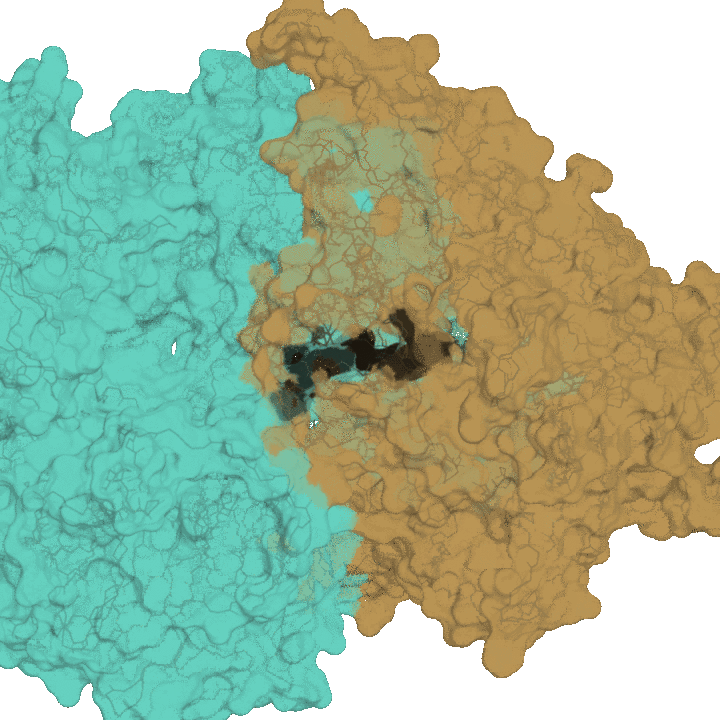
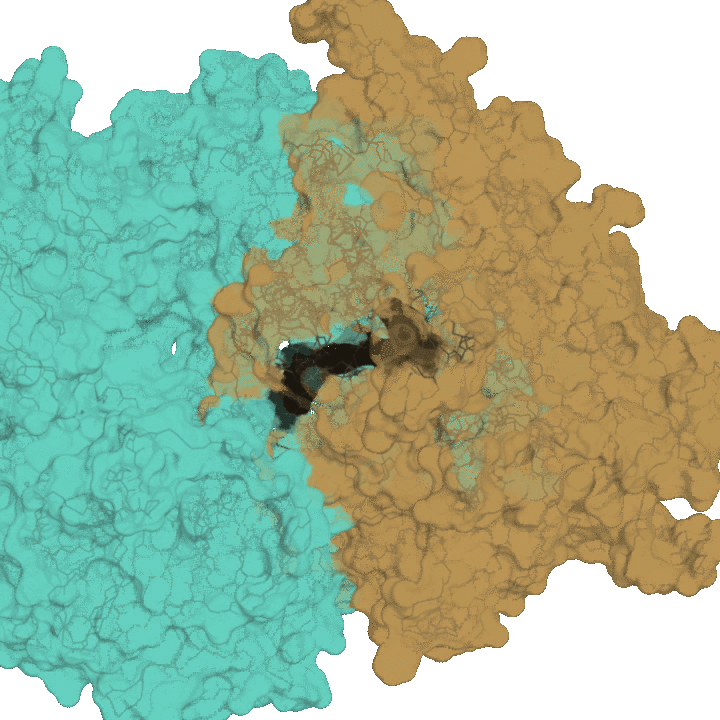
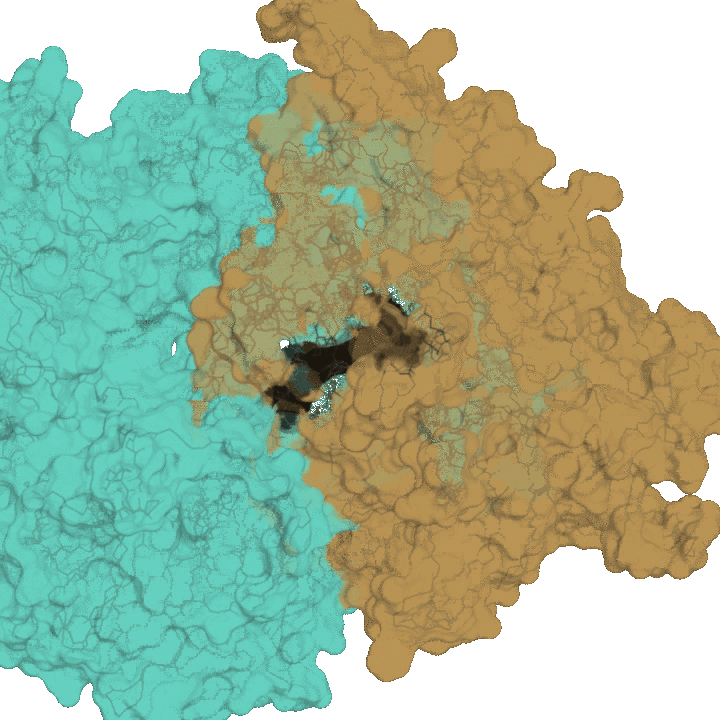
The same two protein modules and the same pair of anchors, re-bridged at different lengths, produce materially different complexes. The bridge is not plumbing between two halves, it decides what the assembly becomes.

Cutaway of the assembly with an extended bridge between the two modules
EXTENDED The bridge holds the two modules apart. Proximity by tether.
Cutaway of the assembly with a compacted bridge, module surfaces approaching
COMPACTED A shorter bridge draws the surfaces together. Contact begins.
Cutaway of the assembly at the shortest bridge, drawn at the construction endpoint
FUSED The shortest bridge, at the construction endpoint. Whether two modules can be accommodated this closely is decided per pair.

Cutaway views of the same modelled assembly, under a single fixed camera so the three states are directly comparable. The designed compound is shown in black as a solid volume only, its chemistry is not depicted. Module colours denote the two halves of the assembly and carry no protein assignment.

The trade-off, stated: intimate contact demands modules that are sterically compatible with sitting against one another. Where two are too large or too awkwardly shaped, compaction is not available and the extended form is the correct design. In one recent determination the engine searched the complete landscape for a fusible arrangement and found none, a negative it could state precisely, and act on. The axis is a range to be chosen along deliberately, not a ladder where the tightest option always wins.

The specifics exist, they sit behind a CDA.

Target pairs, designed structures, ranked shortlists, scoring provenance and programme data are documented and available to partners under confidentiality. Provisional patent applications covering the platform have been filed, and further provisionals covering a four-body assembly architecture and its design pipeline, and partner-directed designs, are in preparation. If you evaluate induced-proximity platforms for a living, the parts worth interrogating are the sampling depth, the gates and the controls, and those are the parts we would rather discuss early than late.

How the engine works →   ·   Talk to the team →